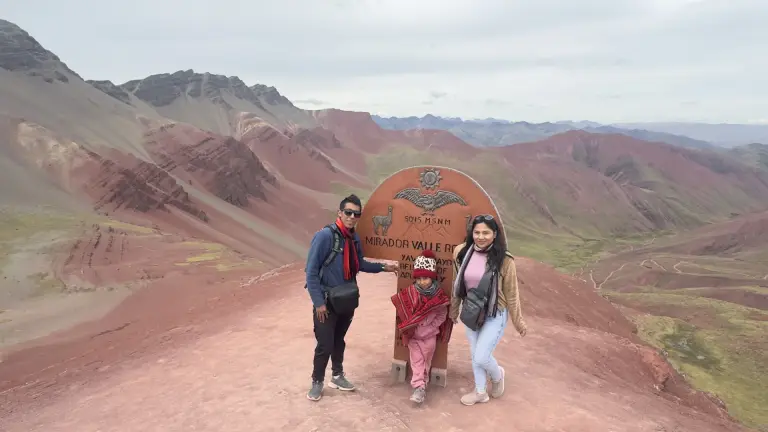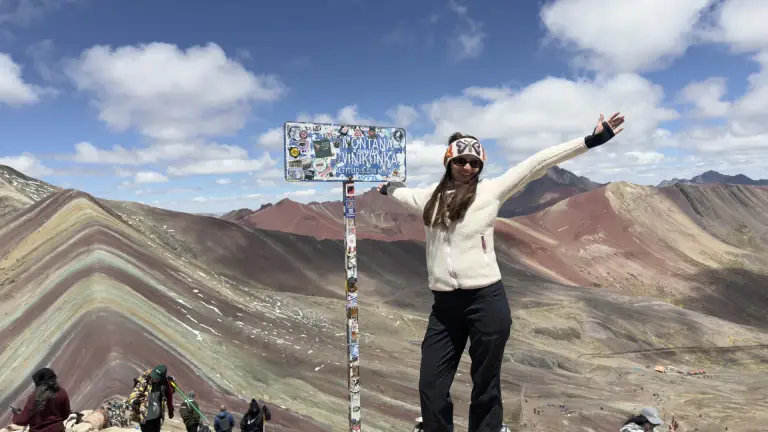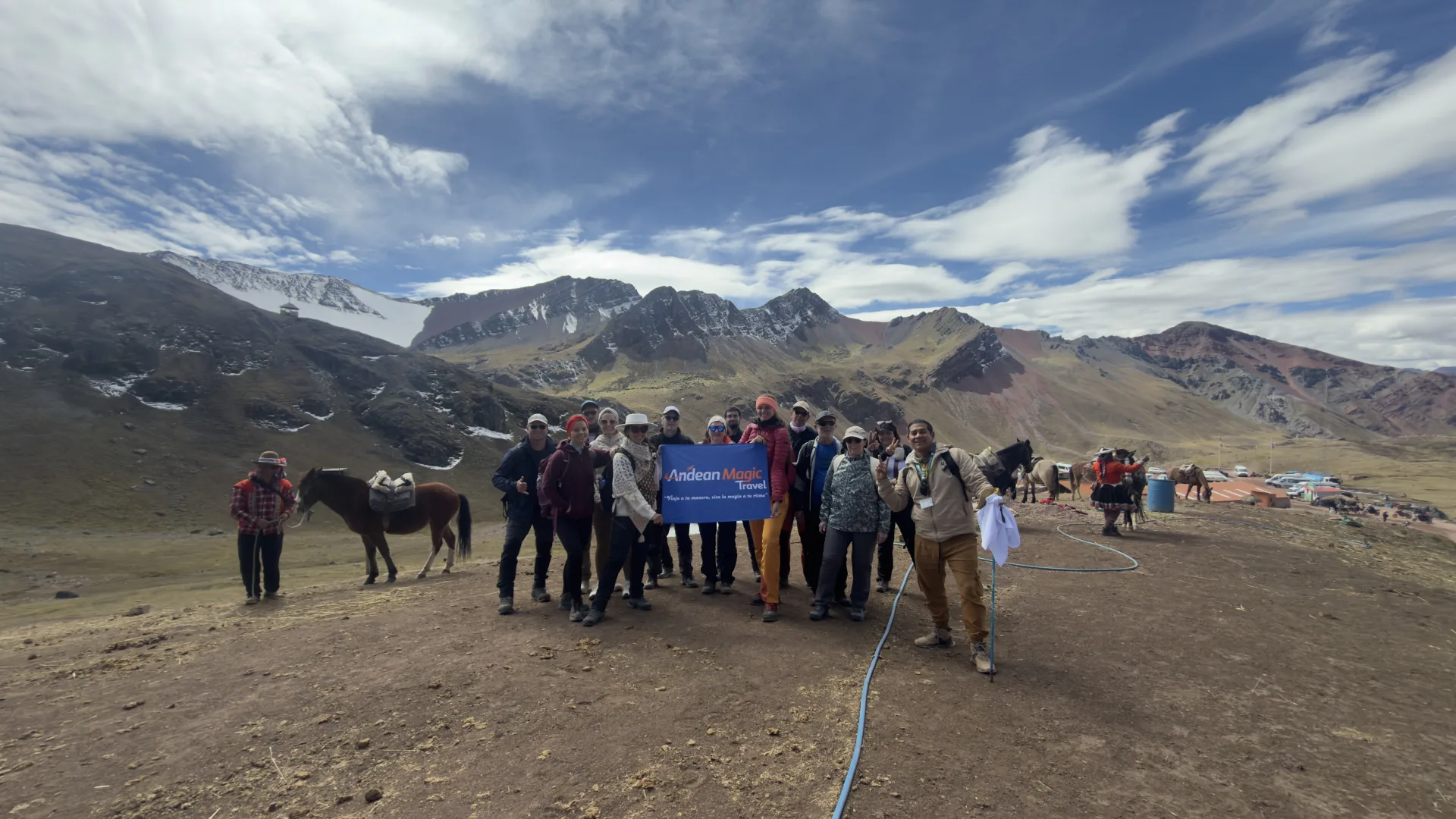
Palcoyo (properly, Palccoyo) is a chain of three rainbow mountains in the farming community of Palccoyo, in the district of Checacupe, province of Canchis, about three hours south of Cusco. It has the same mineral bands as Rainbow Mountain, with one decisive difference: the vehicle gets up to 4,800 metres and from the car park to the viewpoint it is a walk of about thirty minutes on almost level ground. It is the rainbow mountain for those who want the scenery without the climb.
What to see at Palcoyo
- The three rainbow mountains, in a row, with red, ochre, green and turquoise bands. They are seen from further away than at Vinicunca and spread over several slopes.
- Ausangate in the background, Cusco’s highest mountain.
- The stone forest, a field of rock spires at almost 5,000 metres, about twenty minutes beyond the viewpoint. It is optional and decided on the day.
How to get there from Cusco
It is about three hours on the southern road, through Checacupe and Pitumarca, to the car park at 4,800 metres. The practical way is a full-day tour: on our private Palcoyo tour we leave around five in the morning, have breakfast on the way and are back in Cusco by mid-afternoon, in about twelve hours.
Altitude
Even though you hardly walk, the viewpoint is at 4,900 metres, some 1,500 above Cusco, and you feel it. Spend a couple of days in Cusco first, walk slowly and dress warmly. On our tour the guide carries emergency oxygen and the vehicle is a few minutes away. How to plan your first days is in the acclimatisation guide; the altitude of every destination, in our Cusco altitude guide.
Palcoyo, Vinicunca or Pallay Punchu
| Palcoyo | Vinicunca | Pallay Punchu | |
|---|---|---|---|
| Viewpoint altitude | 4,900 m | 5,200 m | About 4,700 m |
| Walk | About 30 minutes, almost level | About 5 km uphill, 1 h 30 – 2 h | Moderate climb to the viewpoint |
| Departure from Cusco | Around 5:00 | 3:30 | 3:00 |
| Length of the day | About 12 hours | About 14 hours | About 14 hours |
| Crowds | Few | Many | Very few |
For the famous mountain and if you are fit, Vinicunca; for the scenery without the climb, Palcoyo; for something different with almost nobody around, Pallay Punchu. We compare the first two point by point in Vinicunca or Palcoyo.
When to go
From May to September the sky is usually clear and the colours are sharp, although dawns drop below zero. From December to March it can snow and the snow hides some of the bands; in return, the landscape is green. Cusco month by month is in the best time to visit Cusco.
Entrance fee and what to bring
The community charges the entrance at the gate, in cash, at about 10 soles; it is not included in tours. It is cold even in the sun: a warm jacket, hat, gloves, sunscreen and water, and a rain jacket from December to March. The full list is in what to pack for Rainbow Mountain.
With children and older travellers
It is the rainbow mountain we recommend for families and older travellers, because there is hardly any walking. The only challenge is the altitude: a slow pace, warm clothes and a couple of days in Cusco beforehand. More ideas for travelling as a family are in the Sacred Valley with children.
Frequently asked questions
Where is Palcoyo Rainbow Mountain?
In the farming community of Palccoyo, district of Checacupe, province of Canchis, about three hours south of Cusco on the road through Checacupe and Pitumarca.
How high is Palcoyo?
The viewpoint is at 4,900 metres and the car park at 4,800. The stone forest reaches almost 5,000 metres.
How much is the Palcoyo entrance fee?
About 10 soles, charged by the community at the gate, in cash.
Which is better, Vinicunca or Palcoyo?
It depends on you: Vinicunca is the famous one and needs about 5 km of climbing to 5,200 metres; Palcoyo has the same colours with an almost level walk and far fewer people. We compare them in Vinicunca or Palcoyo.
Is it Palcoyo or Palccoyo?
The community is called Palccoyo, but signs and agencies often write it Palcoyo. It is the same place.
How much is a Palcoyo tour?
Our private Palcoyo tour costs from USD 120 and includes private transport, a bilingual guide, breakfast, lunch, emergency oxygen and a first-aid kit. The community fee is paid separately.