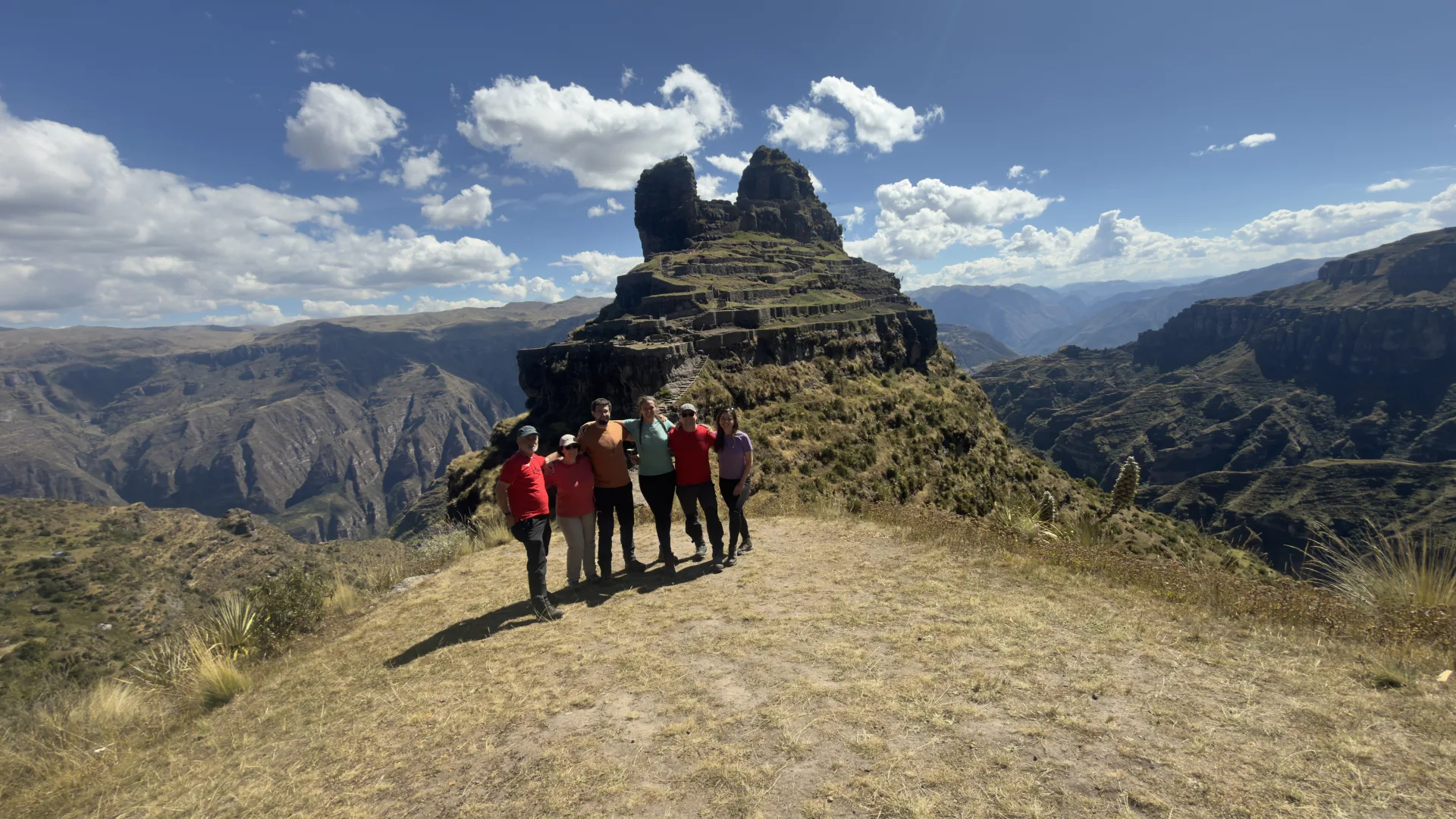

Waqrapukara, “horned fortress” in Quechua, is a sanctuary built on two natural rock towers at the edge of the Apurímac canyon, at 4,300 metres (14,100 ft) according to MINCETUR, Peru’s tourism ministry. That is the altitude of the archaeological site, not of the point where the hike begins. It is one of Cusco’s most impressive archaeological sites and one of the least visited: no road reaches it and you arrive on foot across the high plateau. This guide explains what it is, what the hike is like and who it is worth it for.
What Waqrapukara is
It lies in the province of Acomayo, south of Cusco. It was built by the Canchis, a people who came before the Incas, and the Incas extended it with terraces, fine stone enclosures and a ceremonial square hanging over a drop of more than a thousand metres. The two rock spires that crown it, and give it its name, can be seen from far away. Because of the quality of its architecture and its position, it is interpreted as a sanctuary rather than a military fortress. It was declared National Cultural Heritage in 2017.
How to get there
From Cusco it is about three hours by road to the community of Sangarará, on the Acomayo plateau. From there you can only continue on foot. Our private Waqrapukara tour leaves at four in the morning, with breakfast on the way, and returns to Cusco at nightfall, in about fourteen hours.
The hike
| Detail | Value |
|---|---|
| Start | Sangarará |
| Outbound | 2 to 3 hours, crossing the plateau and descending towards the canyon |
| Return | 2 to 3 hours on the same trail, now uphill |
| Altitude | Above 4,000 m throughout; the archaeological site, at 4,300 m according to MINCETUR |
| Difficulty | Demanding because of length and altitude; not technical |
The path crosses open grassland, with rock formations and ever wider views of the Apurímac canyon. The fortress appears suddenly, on the edge of the cliff. Save some energy: the return is uphill and you feel it.
What you see at the site
- The fine stone enclosures with triple-jamb niches, a feature reserved for the most important buildings.
- The terraces holding up the slope.
- The ceremonial square and the stairways between the two rock towers.
- The viewpoint over the Apurímac canyon, with a drop of more than a thousand metres.
Most days the site is almost empty. It is the opposite of Sacsayhuaman: here your guide explains without competing with other groups.
Who it suits
Hikers in good shape who have spent at least three days in Cusco and want archaeology without crowds. It is five or six hours of walking in total. Community horses can sometimes be hired in Sangarará for part of the way, subject to availability. If you prefer archaeology without the hike, the South Valley is the alternative.
When to go and what to bring
May to October, with clear skies. In the rains the trail gets muddy and the canyon clouds over in the afternoon. Bring sturdy trekking shoes, warm layers, high-factor sunscreen, a cap, two litres of water and snacks. Trekking poles and emergency oxygen are included on our tour. The community fee, 20 soles, is paid in cash in Sangarará. How to prepare for altitude is in the acclimatisation guide.
Frequently asked questions
Where is Waqrapukara?
In the farming community of Huayqui, part of Percca, in the district of Acos, province of Acomayo, south of Cusco and on the edge of the Apurímac river canyon. The archaeological site is at 4,300 metres, according to MINCETUR, and Peru’s Ministry of Culture declared it part of the National Cultural Heritage in July 2017.
How much is the entrance to Waqrapukara?
20 soles per person. It is charged by the community, in cash, in Sangarará at the start of the hike, and it is not included in our tour.
How do you get to Waqrapukara from Cusco?
It is about three hours by road to the community of Sangarará, on the Acomayo high plateau, and from there two to three hours on foot to the fortress; no road reaches the site. The practical way is a full-day tour that leaves before dawn and returns to Cusco at nightfall.
How long is the hike to Waqrapukara?
Two to three hours out and the same back. The return is uphill.
What does Waqrapukara mean?
“Horned fortress” in Quechua, after the two rock towers that crown it.
Is it an Inca site?
It was begun by the Canchis, before the Incas, who extended it with the fine architecture seen today.
Is it crowded?
No. It receives a tiny fraction of the Sacred Valley’s visitors.
Can it be done in a day from Cusco?
Yes, leaving before dawn. It is about fourteen hours in total.
Book
- Waqrapukara, private tour.
- All Waqrapukara tours.
- Things to do in Cusco, for more routes off the usual circuit.