
The Maras Salt Mines and the terraces of Moray are seven kilometres apart on the plateau between Chinchero and the Sacred Valley, and they are the two most photographed places in Cusco after Machu Picchu. They also raise the most questions: which ticket each one needs, whether you can walk into the pools, how much walking there is and how to avoid the hour the buses arrive. This guide settles them.
Moray: the Incas’ agricultural laboratory
Moray is a set of natural depressions turned into amphitheatres of concentric terraces. The largest is about 150 metres across and drops some 30 metres in twelve rings. Between the top ring and the bottom there is a temperature difference of several degrees, which the Incas used, according to the most accepted interpretation, to acclimatise crops from different ecological zones before planting them in the valley. Do not trust the spectacular figures that circulate; what is established is that the bottom is warmer and more humid than the rim and that each terrace has its own irrigation channel.
The visit is a flat walk around the upper rim, with viewpoints over the three depressions. You can go down to the floor of the main amphitheatre by a stairway of protruding stones; down and back takes about twenty minutes and is not necessary to see it well. It sits at 3,500 metres: higher than the valley, lower than Chinchero.
The Maras Salt Mines: three thousand pools on the hillside
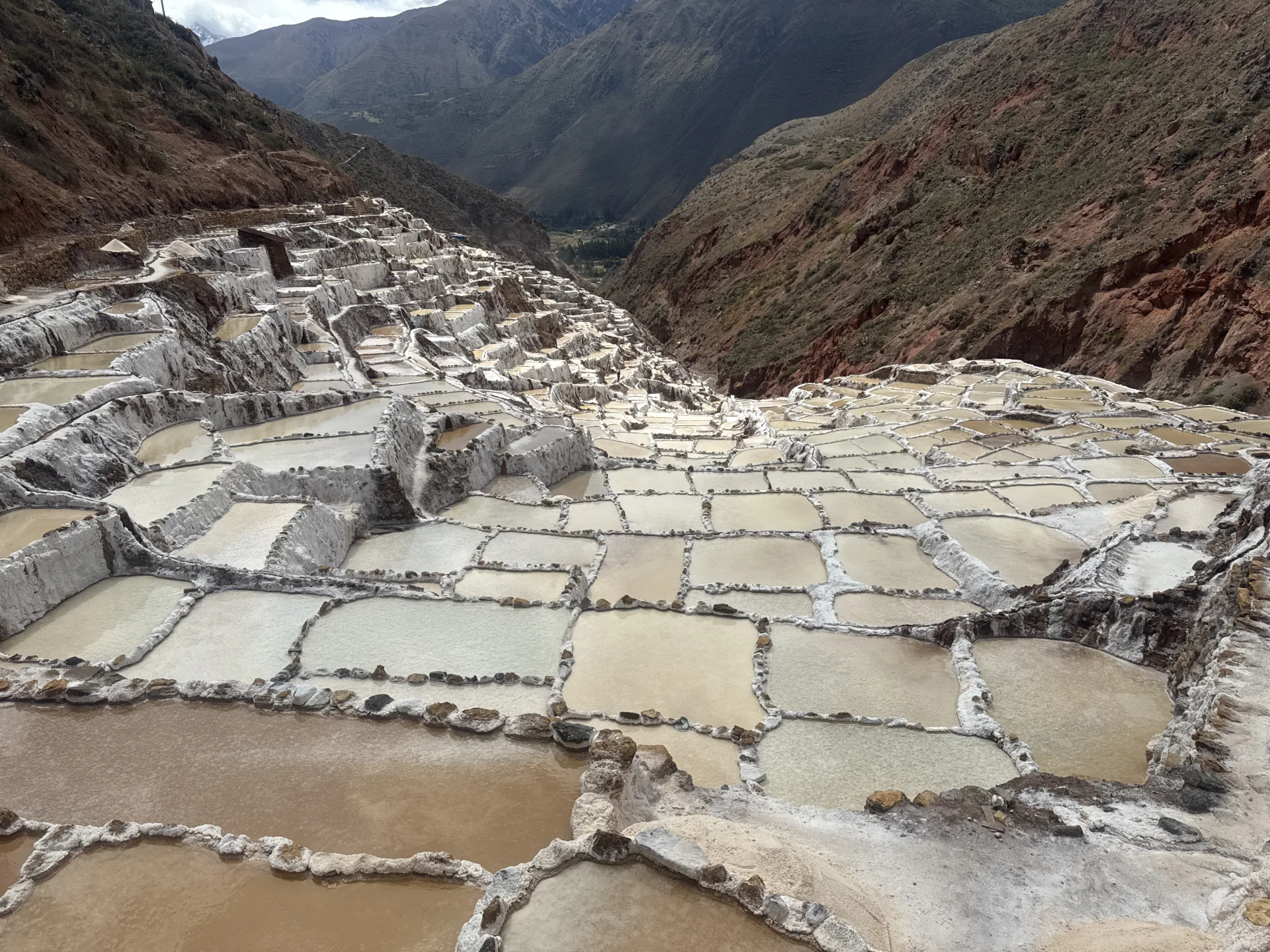
A saltwater spring rises at the top of a ravine and, since before the Incas, the Maras community has channelled it into more than three thousand terraced pools. Each family works its own: fill, let evaporate, scrape the salt, fill again. In the dry season, May to October, the pools are white and full of people working; in the rains they turn ochre and brown, less photogenic but just as interesting. How the valley changes each month is in our Sacred Valley weather month by month.
Since 2019 you cannot walk among the pools: the visit is from viewpoints and a side path, and the best photos are taken precisely from above. There is a small market where the community sells pink salt, bath salt and salted chocolate; it is the most useful souvenir you can buy in the valley.
Tickets: this is where the confusion lies
| Site | Ticket | Guide price |
|---|---|---|
| Moray | Cusco Tourist Ticket (full or Circuit III) | Included in the ticket |
| Maras Salt Mines | The community’s own ticket, at the gate | About 10 soles, cash |
The salt mines are not in the Tourist Ticket and no one includes them in the tour price; they are paid on arrival. Bring soles in small notes.
How to get there and how long it takes
From Cusco, by the Chinchero road, you reach Moray in an hour and a quarter and the salt mines about fifteen minutes further, down a dirt turn-off. Between the two there is a seven-kilometre unpaved track. Independently, the practical way is a taxi from Urubamba or Chinchero that waits at each stop. Some people do the Moray–Maras–salt mines stretch on foot or by bike: about two hours, flat at first and then downhill to the pools.
Best time
Large groups reach Moray around eleven and the salt mines after midday. Leaving Cusco at eight you have Moray almost empty at half past nine and the salt mines before anyone arrives. In the afternoon, from four onwards, the low light turns the pools golden and almost no one is left.
How to fit them into a tour
Both are on the Sacred Valley VIP route, together with Chinchero and Ollantaytambo, in a ten-hour day. If you only want the plateau, the private Chinchero, Maras and Moray tour does it in about seven hours and is back in Cusco mid-afternoon: the option for anyone who already knows the rest of the valley or is short of time. The classic route via Pisac does not come here.
Frequently asked questions
Can you walk into the salt pools?
No. Since 2019 the visit is from the viewpoints and the side path, to protect production. You see everything just as well.
How much walking is there at Moray and Maras?
At Moray, a flat twenty- to thirty-minute walk around the rim, plus the optional descent to the floor. At the salt mines, ten minutes between the car park and the viewpoints. It is among the gentlest outings in the valley, fine for children and older people.
What is the best season for the salt mines?
The dry season, May to October: the pools are white and in full harvest. They stay open in the rains, with less contrast.
Can it be combined with Machu Picchu on the same day?
Not reasonably. The usual plan is the plateau in the morning, ending at Ollantaytambo and taking the afternoon train to visit Machu Picchu the next day.
Follow the route
- Chinchero, Maras and Moray, private, seven hours.
- Sacred Valley VIP, with Ollantaytambo, ten hours.
- All our Sacred Valley tours.