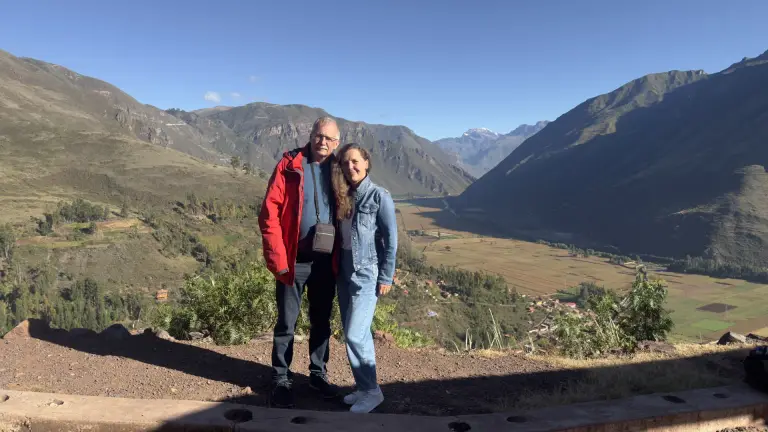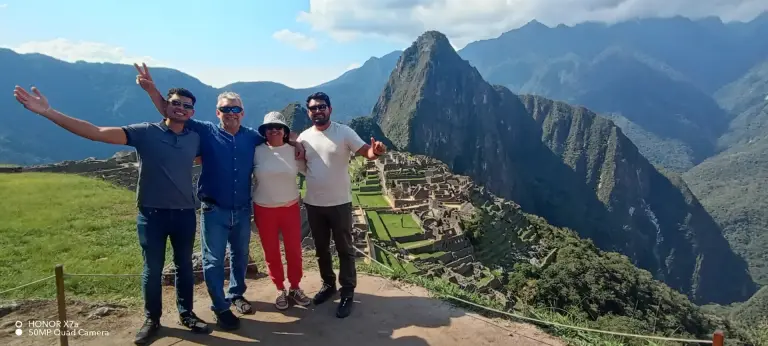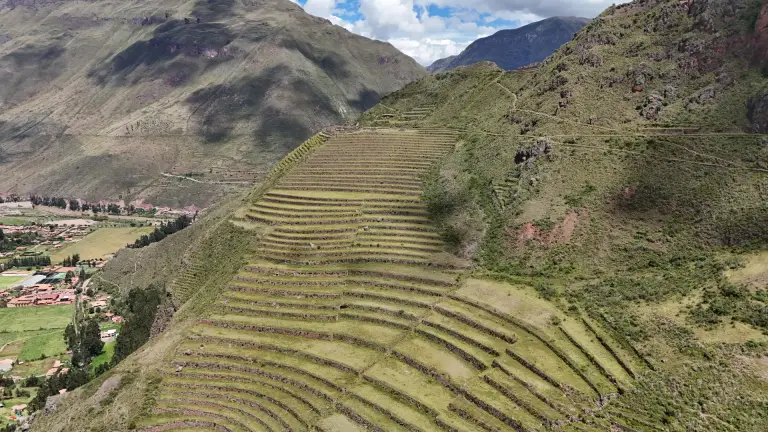
Sleeping in the Sacred Valley instead of Cusco is one of the best decisions of the trip, and one of the least known. The valley is about 500 metres lower, so your body acclimatises better, and from there you reach Machu Picchu without the pre-dawn start from the city. The question is where: Pisac, Urubamba and Ollantaytambo are three very different towns, each with its own advantage. This guide helps you choose.
The three towns in a table
| Pisac | Urubamba and Yucay | Ollantaytambo | |
|---|---|---|---|
| Approximate altitude | 2,970 m | 2,870 m | 2,792 m |
| From Cusco by road | About 45 minutes | Around 1 h 15 | Around 1 h 45 |
| Atmosphere | Small town, craft market, bohemian feel | The centre of the valley: hotels with gardens and restaurants | Living Inca town, stone streets and water channels |
| Train to Machu Picchu | No | Some services; the main station is in Ollantaytambo, about 30 minutes away | Yes, on foot from your hotel |
| Best for | Staying several days at a relaxed pace | Acclimatising in comfort, families | The night before Machu Picchu |
Pisac: for a relaxed stay
It is the valley town closest to Cusco. It has the ruins high on the hill, the area’s best craft market and a quiet atmosphere, with cafés and workshops. It is a good base if you are spending several unhurried days in the valley. Its weak point is the distance to the train station: from Pisac to Ollantaytambo is about an hour. What to see there is in the Pisac guide.
Urubamba and Yucay: the centre of the valley
Urubamba is the valley’s main town and has the widest choice of hotels, many with gardens and views of the snow peaks, and the best restaurants. Yucay, a few minutes away, is a smaller, quieter village. It is the most comfortable area for acclimatising in your first days and the one that works best with children. It is halfway to everything: Pisac on one side, Ollantaytambo on the other, and Moray and Maras above. Where to eat is in our guide.
Ollantaytambo: the night before Machu Picchu
It is the only Inca town still inhabited on its original layout, with the fortress above it, and it is where almost all trains to Machu Picchu depart. Sleeping here lets you take the morning train without a very early start and be at the citadel first thing. Hotels are smaller and simpler than in Urubamba, and in the evening, once the groups leave, the town is very quiet. More in the Ollantaytambo guide.
How to choose for your trip
- A single night before Machu Picchu: Ollantaytambo.
- Two nights to acclimatise on arrival: Urubamba or Yucay, and the second in Ollantaytambo if you go to Machu Picchu the next day.
- Travelling with children or older people: Urubamba, for comfort and altitude. Which route to choose with them is in the Sacred Valley with children.
- Several unhurried days: Pisac or Yucay.
What about sleeping in Aguas Calientes?
It is the other option for the night before Machu Picchu: the town at the foot of the citadel, 25 minutes by bus from the entrance. It lets you enter in the first morning slot, before the trains arrive. In return, it is more expensive and has less charm than Ollantaytambo. We compare the options in how to get to Machu Picchu.
How it fits with the tours
The most comfortable combination is to do the Sacred Valley VIP from Cusco with your luggage in the vehicle, finish in Ollantaytambo and stay the night there. The next day, train and Machu Picchu, returning to Cusco in the evening. We explain it step by step in the Sacred Valley and Machu Picchu in 2 days. If you are already staying in the valley, message us on WhatsApp to arrange pickup from your hotel.
Frequently asked questions
Is it better to sleep in the Sacred Valley or in Cusco?
For the first days, in the valley: it is lower and the altitude is easier to handle. Cusco is more enjoyable at the end, once you are acclimatised.
How many nights should I spend in the valley?
One if it is just the night before Machu Picchu; two if you want to explore it calmly and acclimatise.
Which town has the most going on at night?
None compares with Cusco. Urubamba has more restaurants; Ollantaytambo and Pisac have a few cafés and little else.
Is it warmer than Cusco?
Yes, about three or four degrees warmer by day. We cover it in the Sacred Valley weather month by month.