
Pisac is the gateway to the Sacred Valley and the first stop for almost everyone arriving from Cusco: 33 kilometres and about 45 minutes from the city, it brings together the valley’s largest archaeological park, hanging from the hillside, and the region’s biggest craft market, in the village square. This guide explains what to see in each, how to reach the ruins without wearing yourself out, which days to go and how Pisac fits into a day tour.
Two Pisacs: the village and the park
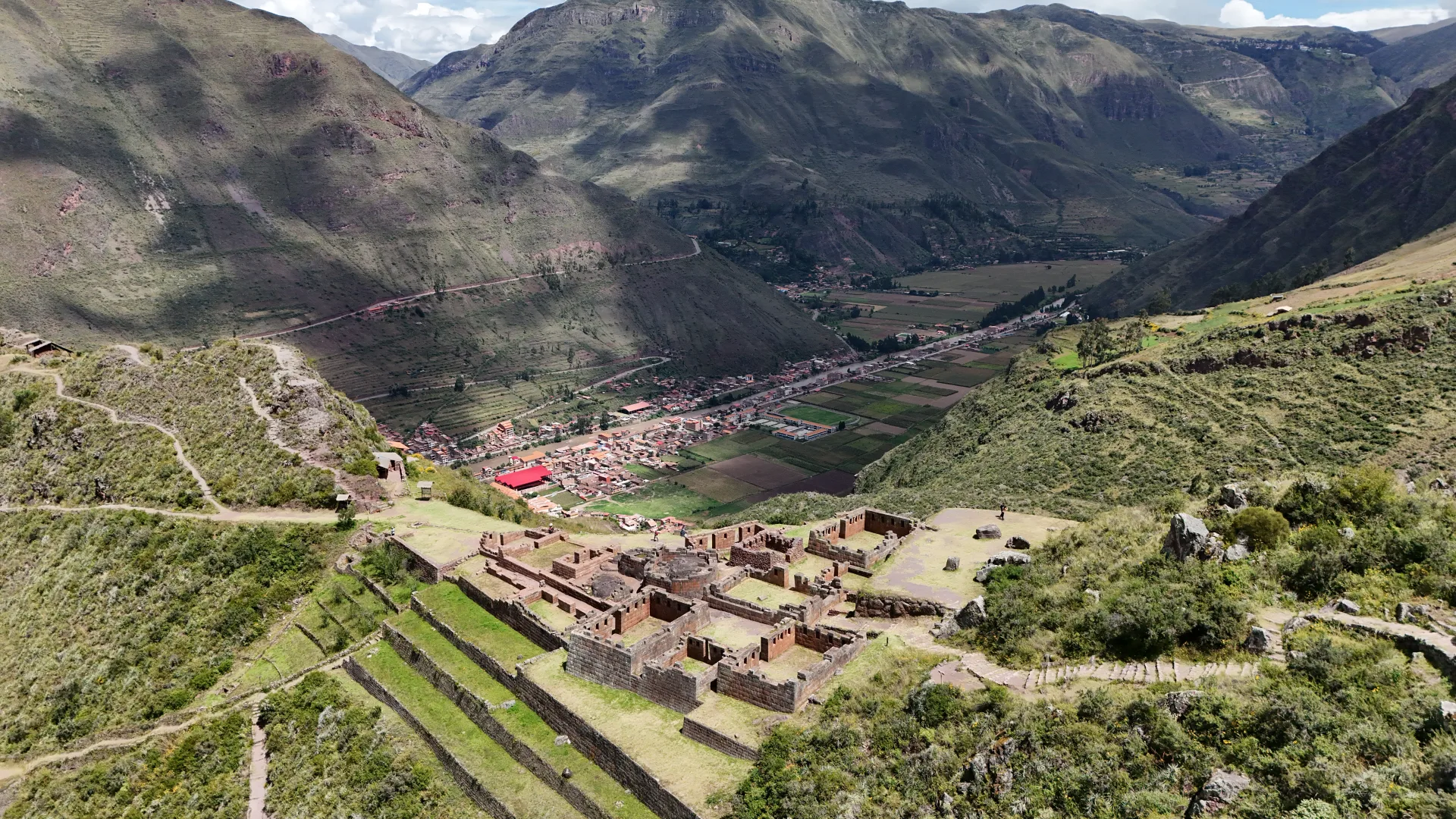
The colonial village sits on the banks of the Urubamba river at about 2,970 metres, with straight streets, a square shaded by a pisonay tree and the market. The Pisac Archaeological Park is 300 metres higher, on the hill overlooking the valley, and stretches several kilometres along the ridge. Between the two there is a paved road of about 8 kilometres to the upper entrance, or a direct Inca trail that takes an hour and a half to two hours on foot.
What to see at the Pisac ruins
- The terraces. Hundreds of curved terraces covering the whole southern slope, still partly in use. They are why Pisac is recognisable from the road.
- The Intihuatana. The ceremonial sector at the top, with a finely cut Temple of the Sun built around a carved rock outcrop. It is the best-preserved section and the one in the classic photo.
- Qalla Q’asa. The residential and military quarter on the highest part of the ridge, with a short tunnel cut through the rock to pass from one side to the other.
- Tantana Marka, the cemetery. The cliff opposite holds thousands of niches dug into the rock, the largest known Inca cemetery. It is seen from the path; there is no access.
- The viewpoints over the valley. From the upper sector you see the Urubamba winding towards Calca. It is where you understand why the valley was the empire’s granary.
How to visit: up by vehicle, down on foot
The sensible way is to drive up to the upper entrance and walk the park from top to bottom. That way the Intihuatana section, which has the most stairs, is done downhill. With a guide, the full visit takes an hour and a half to two hours. On your own, a taxi from the square charges about 25 to 30 soles to the upper entrance. Walking up from the village is a beautiful but demanding hike, with 400 metres of climb above 3,000 metres: it only makes sense from your third day in Cusco.
Pisac market
It runs daily in the square and the neighbouring streets, with the stalls of textiles, ceramics, silver and carvings that fill every photo. The big days are Sunday, Tuesday and Thursday, when producers come down from the communities and the food market joins in. Sunday is the liveliest and also the busiest with groups. If you want to shop without crowds, go on Tuesday or Thursday morning. Bargaining is normal within reason; the opening price usually comes down by 10 to 20 percent.
Tickets and opening hours
The archaeological park is visited with the Cusco Tourist Ticket, either the full ticket or the Circuit III partial, which also covers Ollantaytambo, Chinchero and Moray. It opens daily from seven in the morning to six in the evening. The market has no entrance fee.
Pisac on a tour
Pisac is the first stop of the classic Sacred Valley route, which continues to Ollantaytambo and Chinchero. Since the tour is private, you decide how long to spend at the market: some people are done in twenty minutes, others give it an hour. The VIP route via Maras and Moray does not pass through Pisac; if you are unsure which to pick, we compare Classic and VIP stop by stop.
If you would rather see the valley from above and on foot, the Huchuy Qosqo hike takes you to an Inca site overlooking the Sacred Valley, with no extreme altitude.
Frequently asked questions
How much time do you need for Pisac?
Two hours for the ruins and half an hour to an hour for the market. On a full-day tour the whole morning goes to it.
Can I visit Pisac independently from Cusco?
Yes. Shared minibuses to Pisac leave from Calle Puputi in Cusco and take under an hour; then a taxi to the upper entrance of the park. You will need the Tourist Ticket, sold at the gate.
Is it suitable for children and older people?
Yes, if you enter at the top and walk down. The Intihuatana sector has uneven stone stairs; with small children or delicate knees it is better to stay in the upper part and the viewpoint.
How high is Pisac?
The village is at about 2,970 metres, lower than Cusco; the ruins reach about 3,300. It is a good first contact with the valley for anyone who has just arrived.
How much is the entrance to Pisac?
The ruins are visited with the Cusco Tourist Ticket: for a foreign adult, the Circuit III partial costs about 70 soles and is valid for two days at Pisac, Ollantaytambo, Chinchero and Moray; the full ticket costs about 130 soles and lasts ten days. It is sold at the gate, in cash. The market has no entrance fee.
How long does it take to hike the Pisac ruins?
Walking up the Inca path from the village takes an hour and a half to two hours, with 400 metres of ascent. Alternatively, a paved road of about 8 kilometres reaches the upper entrance (a taxi from the square costs about 25 to 30 soles). The easiest plan is to go up by vehicle and walk down.
Is Pisac higher than Cusco?
No. The village is at about 2,970 metres, some 430 metres below Cusco; only the ruins, high on the hill, reach about 3,300. The altitude of the whole trip is in our Cusco altitude guide.
What to buy in Pisac?
Textiles, ceramics, silver and carvings. The big market days are Sunday, Tuesday and Thursday; for calmer shopping, go on a Tuesday or Thursday morning.
Are the Pisac ruins worth visiting?
Yes: it is the largest archaeological park in the Sacred Valley, with terraces, temples and, on the cliff opposite, the largest known Inca cemetery, and below it the region’s biggest craft market. All at the first stop in the valley.
Follow the route
- Where to stay in the Sacred Valley: Pisac, Urubamba or Ollantaytambo, depending on your plan.
- Classic Sacred Valley: Pisac, Ollantaytambo and Chinchero in one private day.
- All our Sacred Valley tours.
- How to acclimatise in Cusco before hiking up to the ruins.